Archive for the 'Uncategorized' Category

Day 14: Float Plane + Chicken

Day miles: 440
Trip miles: 5685
Talkeetna to Chicken

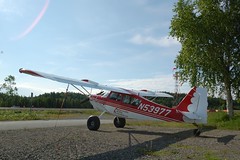
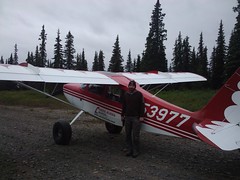
When I was a kid, my father used to fly us into camp deep in the north Maine woods in his friend’s Piper PA-12 Super Cruiser float plane. So, it was a special treat to get up this morning and fly a Piper PA-18 Super Cub on floats with Lance. The Super Cub is my kind of plane; it is simple, and capable. Developed over sixty years ago, it is still considered one of the best bush planes ever built. I hadn’t flown a float plane before, but with a couple exceptions and a few different techniques for takeoffs and landings, they fly like any other plane. We covered these, and how to determine wind on the lake from the air, then went to a few lakes to practice.

The Super Cub is also very similar to the Super Cruiser of my youth, and thus evoked powerful meaning and memory. Before leaving on this trip, I spoke to my counselor about how I was struggling with the frustratingly thin and banal recommendation that I make no life-changing decisions in the wake of my fathers passing. With her usual balancing grace, she offered that death often reminds us of our own mortality, prompting a fresh look at our sometimes dusty priorities. My consistently introspective nature had already provided me with the shape of these potential life changes and part of the motivation for the trip was to provide definition to them. One of these was to get back to flying, and my experience with Above Alaska definitely laid solid groundwork.

After getting back to the hanger from the lake where the Super Cub is kept, I said my goodbyes to the folks at Above Alaska Aviation. Leaving was difficult, as I was getting attached to them as well as the town, but it was time to get back on the road. I had packed up camp and loaded the bike first thing in the morning, so I was ready to go and headed out south on the Parks highway.

I stopped in Wasilla at Sportsmans Warehouse and found a great dry-bag for the shotgun to solve my issues with water getting on the firearm. I wish I had known about this product before I left. I didn’t “see Russia” while in Wasilla, but I saw plenty of pawn shops. But really it was like any other American city sprawled out around automobile use, but scaled for Alaska. After a meal I was happy to continue on out of town.

From here I took the Glenn Highway to the Tok Cutoff to get back to Tok. While the later doesn’t sound like a large highway by name, it is 125 miles long. Like the rest of Alaska, the roads were lined with stunning mountain ranges to enjoy. From Tok, I continued to the northeast up the Taylor and Top of the World highways.

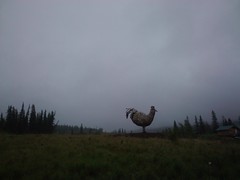
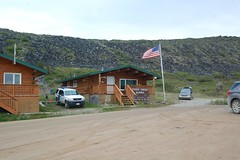
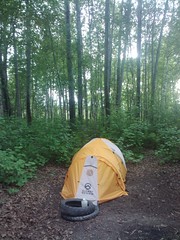
Evening found me in Chicken, Alaska, tired and hungry. The town has a little bit of an identity crisis; it appears that a couple businesses providing the same services are battling over customers with signage; but it definitely had character. After futility visiting a couple stores in town in search of hot food, I decided to set up my tent and get some breakfast in the morning. I was starting to get amused by all of these small towns having slightly different products in their gift shop. Alaska and the Yukon were full of bumper stickers that read “A quiet little drinking town with a _______ problem,” as well as an assortment of slightly different t-shirts that must have come from the same location.

I mentioned the other day that my mother had remembered reading about Don Sheldon when I told her I was staying in Talkeetna. I found a copy of this book here in town, and picked up it up for when I finished reading “Double or Nothing: The Flying Fur Buyer of Anahim Lake” which I had picked up in a gift shop along BC97 somewhere.

Day 13: More bush flying

Day miles: 58
Trip miles: 5245

I had plans to fly twice more today to finish up the bush course with Above Alaska. The first flight would be upriver late in the morning to practice landing on the gravel bars. However, the cloud cover was quite low in the morning and we spent some time at Talkeetna’s FAA Flight Service Station (FSS) observing the weather report and discussing the forecast. Drew of Above Alaska, was confident the weather would stay high enough for such a flight along the rivers, which convinced my instructor enough and we planned to reconvene in an hour to start the flight.

The training focused on “pioneering” an airstrip; how to determine if it was long enough and good enough to land on, and then to take off from again. There is some overlap with training from other areas, but the repetition builds skill and the experience was great. Flying provides an unparalleled way to explore areas otherwise difficult to access and over the days of flying the rivers with Above Alaska they pointed out numerous amazing geographical features, such as the mighty high speed waters of Devils Canyon on the Susitna river.

Later that day, when conditions improved marginally, we headed back into the mountains for our final flight. The plan was to visually navigate (all navigation is visual here) around some mountains and up some valleys to a gravel airstrip at around three thousand feet. We had a “sectional chart,” a type of aviation map, with a line drawn on it for the route to the strip to follow. My mountain training a couple of days ago was reinforced here in the tight space between the mountains on both sides of the landing strip.

There was a small camp here, probably for mining, in a beautiful spot. As I retrace our route on Google Maps, I cannot underscore enough how amazing it was flying there and how poorly this is conveyed by the satellite imagery.

The flight was a little eventful, carefully watching the weather ahead and behind us as to not get closed into the mountains by the clouds. Additionally, while circling the landing strip another small airplane with skis unexpectedly came down out of the mountains and flew nearby toward Talkeetna. We didn’t doddle long here, as to not give the weather more opportunity to sock us in, and were soon flying back out of the mountains into clear weather.

I made the decision this evening to leave the next day and go back on the road after one more flight with Lance in the morning. This was hard, as I had grown attached to both Above Alaska and Talkeetna, however I hadn’t come to Alaska to start a new life. Not having a clear plan for flight training while I was here, I decided some more miles would do me good.

I had found upon arriving in Talkeetna that the Dalton Highway had not treated my trash bag system from waterproofing my shotgun well and the barrel had picked up some rust. Unfortunately the bags held water as well as they repelled it. I dried everything out and wrapped it better with fresh garbage bags from the hardware store. I decided to ride with it atop the bike despite being a bit more obvious as to its contents and search for a better solution in the next city.

Day 12: Bush flying

Day miles: 6
Trip miles: 5187

Today began with an early flight up in Above Aviation’s Citabria and with it a new instructor. I took what amounted to their bush course. This was somewhat complicated by the fact that much of their training seemed centered around already having a private pilot certificate, which I haven’t gotten around to doing. However, this is more about having a certain amount of experience already. Since I have a fair amount, it shouldn’t really be an issue, but my new instructor was uncomfortable and unsure as to exactly what to do with me. He clearly had a lot of training, however the bush flying seemed still somewhat new to him. In all aspects of my life, I take the approach that we’re always learning and never experts, so I was aiming to grow in whatever way this unique experience would lend to me.

The first flight was getting familiar with the aircraft and doing some pattern landings. These airplanes are all tail-draggers, sometimes called “conventional landing gear.” This means that they have to main wheels in the front and one pivoting wheel under the tail, as opposed to tricycle gear aircraft that that the third wheel in front of the main gear under the nose of the plane. Tailwheel landings are different than landing a typical trainer airplane, but I’ve done more than a few of them. The hardest part was getting used to the new instructor, the difference in his expectations, and how he controlled the aircraft while I was flying. This was the only instructor I’ve flown with would silently modify the controls, yet tell me to “not fight him [on the controls].” This was confusing and I left this flight at a personal low.

It wasn’t just the flight though. t was Sunday and I used to talk on the phone with my father everyone Sunday afternoon. They continue to be the hardest days of the week for me in regard to dealing with his death. Additionally, it was father’s day, the first since he passed. There was no escaping the reminder of this: Above Alaska had a fathers day special, social media was full of people commenting on it, everyone at the restaurants and bars was talking about it. Finally, it was the three month anniversary of my fathers death. I put this together midday and spent some time talking it out with family. I struggled over what to do next.

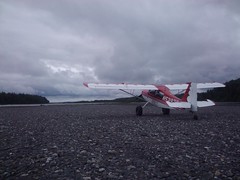
I stuck through, and flew the Citabria again later that day. I switched seats with the instructor, which seemed to make him more comfortable and find a bit groove for himself. This plane has large Alaska Bush Wheels on it to aid in “off-field” landings, as well as a Short Takeoff and Landing (STOL) kit, making it particularly suited to bush operations. We went out and made some landings on gravels strips in the mountains and I had a good experience.

As we departed the airplane on our first landing to look the strip over, the instructor asked if I wanted the handgun or the bear spray. He seemed less than comfortable with the revolver, which was fine with me as I had more faith in the handgun. I brought a shotgun and bear spray with me on my trip only because I couldn’t bring a concealed carry handgun through Canada. The latter would have been much more convenient to carry on the motorcycle and I would have been more comfortable knowing it was always on me.

This, combined with walking around the airstrip with the instructor occasionally yelling “Hey bears!” provided a little humorous fringe to the great bear firearm debate/research the preceded my trip. I am in the “I would rather have a firearm and not need it, than need it and not have it” camp, except the shotgun is physically over-sized for motorcycle camping. The internet wasn’t much help in deciding a reasonable level of preparedness.

Day 11: Flying mountain rivers

Day miles: 33
Trip miles: 5181

I continued my mountain flying training with Lance today, going up into the Talkeetna mountains following the rivers. I had been driving in the mountains for over a week and most of the roads followed rivers. However, there were few roads here as we followed the rivers up into the mountain passes. With Talkeetna being at the confluence of three rivers and like the rest of Alaska, surrounded by mountain ranges, there was no shortage of terrain to fly.

It was also about time for an oil change for the bike. I had brought a filter and oil with me. This wasn’t the best plan, as I did not need to carry four quarts of oil for five thousand miles and should have planned better to pick this up locally. I had also brought tools and a oil filter wrench that I had confirmed to fit, although there was some debate due to it not fitting on a friends bike. As it turned out, it wouldn’t fit the new filter I brought along as it had a different grip pattern. This was fine, as you can usually get a filter on tight enough with your hand. More amusingly, the Cruz Tools BMW Tool kit I had purchased did not have the 10mm allen wrench that I needed to remove the oil plug. So I headed off to the hardware store for this.

I didn’t bring any funnels for adding or draining the oil, but had picked up an empty one gallon plastic bottle from an auto parts store somewhere to drain the oil into. This was a slightly precarious setup: using the oil plug to control the flow of oil leaving the engine so it would go in the one inch diameter opening in the bottle. I was managing well enough, until a bumble bee became interested in what I was doing. I couldn’t help but appreciate the humor of the situation as I was blowing at the bumble bee trying to get it to go away since both of my hands were occupied in this oil draining stunt.

Eventually the bee landed on one of my hands, which reflexively twitched and I lost the drain plug. I looked all over for it while adjusting the bottle so oil would continue going into it. Eventually, with a shake of my head in disbelief, I discovered that the drain plug had managed to go into the bottle. A balancing act with the bottle and its cap got the plug out without making much of a mess.

With some patience I swapped the oil filter, finishing up the change and cleaned up. I stand by doing oil changes for myself, but I should have planned the logistics a little better. With some footwork, I found that the local transfer station would take the used oil for recycling free of charge.

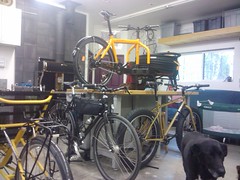
I had been scheming for some time about what to use for a spacer to tighten up a loose RAM mount on my handlebars. Returning from the hardware store I noticed a sign for WeCycle along the Talkeetna Spur Road and decided to stop in to see if I could salvage a used bicycle tube from them. It was there I met Ralph and when I saw his shop I was amazed; it was filled with cargo bikes and Surley Pugsleys. From the sign at the road I expected someone scratching together bikes from what other people threw out. As it turns out, Ralph has some partnerships with shops in Portland, OR for getting cargo bikes. He uses one himself to cart around a baby, and sells a fair number of Pugsleys as snow bikes to locals. Being a ways out of Talkeetna, it didn’t seem that he did much work with the tourists, but enough work came from repairs and a little sales to the locals to get buy. He was incredibly friendly and I stuck around for a while talking bikes with him; another meeting that made me feel quite at home in Talkeetna.

I noticed later back at the West Rib bar that Bar Harbor, Maine was written on the wall here. I enjoyed this, having already compared Talkeetna to Bar Harbor, as well as finding a little bit of a connection to home here.

Day 10: Flying Denali

Day miles: 315
Trip miles: 5148

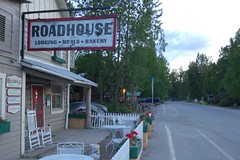
I had plans to fly with Lance from Above Alaska Aviation again in the morning, so I awoke early. I got to the Talkeetna Road House just about when they were opening the sitting rooms for breakfast. Due to the dietary requirements of mountain climbers, they offer their plates in both a “half,” and a “full” serving. The half is plenty of food. After managing to finish this off, I awaited for their public laundry room to open officially at eight. I did some laundry, charged some devices and made some more phone calls.

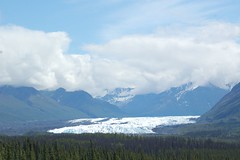
Lance and I took the Champ up to Denali National Park. After discussing some mountain flying techniques, we entered the Ruth Glacier and started climbing. We passed through the mile wide “Great Gorge,” supposedly one of the deepest in the world if you measure to its bottom, and came out into the Ruth Amphitheater. This is also respectfully referred to as the Sheldon Amphitheater for Don Sheldon, Talkeetna’s famous pioneering bush pilot. My mother had mentioned the evening before on the phone that she had read a book years ago, probably up north to camp, about a famous bush pilot from Talkeetna. She recalled his name, and it was the first I had heard of him. I’ll have much more to say about this later, perhaps once I get home. I wouldn’t know the full meaning of my decision to head to Talkeetna for flight training until days after I had left.

However this flight was ideal. I was able to both gain some unique flying experience, and see Denali in a much more meaningful way than driving by it on the Parks highway. My mother remarked, “somehow I think your dad was your copilot.” I agree. This was exactly the kind of flying I was searching for. I had no interest in going up for a tour flight with a number of other passengers equipped to the hilt with camera equipment. A few photos wouldn’t have been bad, but I was happy to just fly. I cannot convey this passion with words, but I had no need to as I found myself here among friends.

That afternoon I rode back to the road entrance to Denali National Park to take a couple of pictures and look around. There is a small village on the outskirts of the park, consisting entirely of hotels, gift shops and tour companies. I managed to find someone to print a copy of my flight logbook that I had my roommates email to me, and grab some food before heading back. This ride also added a fox to the list of wildlife I had seen along the road.

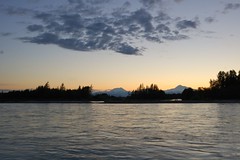
Back in Talkeetna I settled in at the West Rib bar, which would become my regular evening stop when I didn’t have to get up early to fly. I had a beer and then wandered around the river bank at the summer sunset. This town was definitely growing on me.

Day 9: Talkeetna

Day miles: 292
Trip miles: 4833
North Pole to Talkeetna

In the morning I found the bike charged and ready to go. After fueling up and spending some time at the car-wash getting the infamous Dalton Highway mud off my bike, I headed for the Parks Highway toward Denali National Park. I had found Above Alaska Aviation on the internet when searching for flight instruction in Alaska and decided I drive to Talkeetna to check them out.

I was glad to be back on the bike, and also to get out of the Fairbanks area. This was the only place I had ridden highways with more than two lanes since Vancouver, BC and I wasn’t liking it much.

The George Parks Highway was beyond words. You’re surrounded by mountain ranges and little else for hundreds of miles. I didn’t bother taking many photos on the way down; what to take a photo of? There is no centerpiece here, just endless mountain ranges and wilderness. They act as the picture frame to everything that you do here.

The ride was short relative to much of my prior days, so I made it to Talkeetna early and wandering around a bit, taking in the place. It immediately reminded me of Bar Harbor, Maine. Bar Harbor is about forty-five minutes drive from where I grew up, depending on the season. In the summer it can take forever due to traffic, but in other months it can be faster. It is a tourism driven town, bustling with activity in the summer as visitors come to nearby Acadia National Park. Talkeetna is the base town for those wanting to climb Mount McKinley, usually taking a glacial flight from here to about seven thousand feet up the mountain. When the tour buses were in town during the day, everything was packed, but in the evening it starts to quiet down to climbers, straggling travelers and seasonal workers.

The bulk of my flight training was ten years ago, although I did a few hours in a J-3 Cub three years ago. I did that training with George Kirkish of Vashon Island Air specifically because I thought his training in a tail-wheel airplane was the kind of instruction I wanted. In general, flying in a small airplane as opposed to a commercial airliner is like riding a bicycle or motorcycle instead of taking the bus. In both latter cases you have all the time you want to look out the window, but you tend to just yawn and do something else before too long. The old trainers like the J-3 are simple airplanes but that makes them better airplanes because you’re encouraged to focus on learning to fly where modern airplanes often have niceties to make flying easier, like an automatic transmission makes it easier to drive a car.

I didn’t intend to finish my training in Alaska; I would have had to have planned better, including bringing my pilots logbook for starters. But I hoped I could get some unique training from Above Alaska like I had from Vashon Island air, where I was challenged to fly the plane and build the skill. I walked into the hanger where I met Lance, one of their instructors. I told him my story and scheduled to go up with him in their trainer, a Champ, much like the J-3, later that night.

I liked the Champ. It was very much like the J-3 but had better forward visibility, particularly when taxiing on the ground. We spent about an hour flying around and getting used to the plane, as well as some low altitude river flying, and then landed. It was great to be in a small plane again and I was glad it was going to work out. Not only was I in Alaska, but I was flying in Alaska, and in respect to my father this was a particularly meaningful thought to have as I looked out of the cockpit over the wilderness landscape.

I set up camp at the RV park that doubled as a boat launch along the Talkeetna River. There was a system of unofficial trails leading from here into town and plenty of space to wander around as I caught up on more phone calls due to there being service here. “Beautiful downtown Talkeetna,” as the signs and bumper stickers say, is centered on a single short street and therefore is very walkable. I planned on being here for at least a couple days to see what I could glean from flight instruction here.

Day 8: Stuck in North Pole

Day miles: 0
Trip miles: 4541

That is North Pole, Alaska, not THE North Pole. However, they do have a pole which they had dropped from an airplane at the magnetic north pole and then recovered by a search party.

After catching up on sleep and the internet in my hotel room, I loaded the bike back up in the early afternoon only to find the battery completely dead. It is debated as to if you can push/bump start a fuel injected bike. A young kid outside a hardware store would later tell me that Arctic Cat makes EFI snowmobiles that don’t have a battery, so it’s gotta be possible. Nevertheless, the bike was heavy and I was not on the top of a big hill to try.

I asked a contractor working nearby to give me a jump, and he sent one of his workers over with a pickup truck. He was impatient though, and the bike wouldn’t immediately start once I got the cover off and the cables on, so he took off. I debated calling BMW Roadside Assistance, but was reluctant because I knew I would have to work at finding someone helpful.

I called up Dan at Adventure Cycleworks and talked it over with him. He was very helpful and gave me the number for the local Harley dealer that also sold BMWs, as well as the part number for the battery and some other contacts. The dealership would have a battery the next day, but of course I had to get the bike there myself if the service department was going to be any help.

I checked back into the Hotel North Pole, getting my old room back at a discount because they hadn’t cleaned it yet. They mentioned that they had a jump-starter and I took them up on it. I expected it to be one of those battery packs that you can plug into your cigarette lighter outlet, or maybe the same with clamps, but in fact they had a really nice standup battery charger with a built it jump-start setting. Because it gets so cold in Alaska, there are outlets in the parking lot for hooking up engine block and battery heaters when parked overnight, convenient for running the battery charger as well. The bike has a small sealed battery, so I put the charger on low and let it sit. This time, I noticed that the fog light came on as soon as I hooked up the charger. The fog light has a toggle switch, as well as a relay that so it won’t come on unless the headlight is on as well, so this was odd. I had already replaced the relay once because it wasn’t closing, but now it was stuck open. Rather than muck with it, I pulled the fuse for the fog light.

Then I walked over to the NAPA auto parts store for a battery tender. Because it was down the highway, I got walking directions from Google and wandered threw a maze of residential streets. North Pole started growing on me, as the developments were just dirt roads with nice small homes and cabins. I happened past the visitor center along the way, and stopped in on my return trip. They were incredibly friendly there and I got the map tour of town as well as the opportunity to send a post card and have the stamp cancelled from North Pole. One of them had to make a trip into town and even gave me a ride back to my hotel.

I came back and the bike started fine, so I switched to the battery tenderer, which had a lower charging rate which is easier on the engine and so that I could return the nice [expensive] charger to the hotel. I wandered around a bit for a meal, and found a local department store where I picked up an AC charger for my phone and some Brenneke Black Magic shells for the shotgun. Convenient town, this North Pole is.

I decided I would trust the battery and not go back into Fairbanks in the morning for a replacement at the dealership. The day off hadn’t been too bad as I got the opportunity to rest and talk to some people close to me. Tomorrow I would head back on the road. I hadn’t been sure of what the middle of my trip was going to be when I left Seattle, but I determined that I would first try to get some flight training in Alaska, and if I couldn’t satisfy that I would ride down the coast for a couple of days. Either way, I was headed toward Denali National Park.

Day 7: Back to the interior

Day miles: 529
Trip miles: 4541
Deadhorse (Prudhoe Bay) to North Pole

I was up early this morning to settle up with the hotel and have some breakfast before the oilfield tour. The day begins with opening the shades to see the sun. Notably, there is no sunrise here. Google says,

These days, the sun never sets in Deadhorse, AK.
The next sunset is in 40 days.http://aggregate.loftninjas.org/wp-admin/post-new.php
1:28am (AKDT) Jul 29 2011

Deadhorse isn’t a walkable town. I decided I would leave my gear at Deadhorse Camp rather than try to find a place to leave it at the Arctic Caribou Inn where Tatqaani Tours is. This meant it was very cold riding the bike between buildings. Fortunately I followed a couple in their vehicle, as I didn’t know the way and probably would have gotten lost and colder.

I ran into CJ and friends again, the three adventure riders out of Wisconsin that I had met in Fairbanks. They were coming on the same tour so we got to catch up a little and joke around. They show a short film at the beginning of the tour, which is mostly a BP propaganda film. As best I can tell, extracting oil actually improves the environment and helps endangered species reproduce, growing up healthy. I’m not really sure how, but that’s the way it is.

The only buildings we weren’t allowed to take photos of were the security shacks, which was a little amusing as they’re just a shack. There’s nothing fancy there to plot against. Anyway, you spend the whole tour in the bus except for a stop at the failed “East Dock” where you can take off your shoes and put your feet in the water, if you want. I still don’t understand why I would want to do this. It sounds cold, and taking off my boots and two layers of socks didn’t sound that great either. I guess I’m just not any fun. I took a few photos, but I had brought my wide angle lens and the road was pretty far from everything.

The tour was full of interesting information from our security office/guide about people working up on the slope and the history of drilling up there. Occasionally we stopped so people could take pictures of a bird or some other furry animal of some kind.

The strangest part was being on the edge of the continent. It had been three thousand miles of driving since I left Seattle and I was five hundred miles from a city. It isn’t that rare to spend an entire day heading away from civilization, but to do so averaging sixty miles per hour takes you awfully far away. The town, the landscape, the bleak ocean, everything adds to the feeling of remoteness. While talking to a mechanic working on the stove at the camp about my trip, he remarked, “so you’re doing your fathers bucket run.”

I suppose he was right, I always wanted to go to Alaska, but so did Dad. Thinking about this started shaping the rest of my trip after Deadhorse as well. Other events, like the float planes at Moon Lake and the people in Manley had reminded me of my father, I knew he would enjoy these.

While overhearing someone talk about themselves too much on the tour, for a moment I lost faith. They were preaching their accomplishments out loud to another rider. I started to wonder, why was I so far away from home, which has recently firmly returned to Maine and so alone, out here? I’m not the sort of person who measures themselves against other people, but sometimes I fall into the trap of doing so. Reaching Deadhorse was also a personal challenge.

Somewhere on the trip I caught a video on public television about Alaska bush pilots. One of the pilots being interviewed, when asked about the dangers of being a bush pilot, stated that he realized he could die anytime he flew, but he was alive. Flying, dangerous or not, was a reminder that he was alive.

Driving my motorcycle up the most remote highway in the United States, to the edge of the continent, hundreds of miles from civilization; this is not a safe or smart idea. But these are the challenges that define us. I’ve had many conversations with other motorcycle riders who want to take a trip like this since I’ve left, and my advice to all of them is that they just need to go. That’s it, go. That is how I ended up standing on the ice of the Arctic Ocean.

After the tour I managed to find and figure out the gas station, as well as track down a gift store. I checked in with CJ about their plans, which were to camp just north of Coldfoot. I told him that I’d camp with them if they showed up in Coldfoot before I finished dinner.

The ride south was easier this time. I was familiar with the road and the weather was about fifteen degrees warmer. I caught a picture of a bear but I’m not sure what kind it is. I’m pretending it is a Grizzily/Polar hybrid because they sound cool.

I didn’t see CJ by the time I was finished with dinner and gassed at Coldfoot and it was only about 5pm so I decided to make Fairbanks that night. Five or six hours later, I was back in the city. I stopped at the first hotel I found and was told that most of Fairbanks would be booked but I could get a room fifteen miles down the highway at North Pole. I had driven through North Pole on my way north and thought the town looked pretty cheesy, but I just wanted a bed, so off I went. I eventually found the place in the back of a mall parking lot. The sold me a “mini-suite” at the price of a double, which meant I got a fridge. Whatever, I just wanted a bed. I dumped all of my gear in the shower, ordered pizza delivery and got some much needed rest.

Day 6: The Haul Road

Day miles: 493
Trip miles: 4012
Manley Hot Springs to Deadhorse (Prudhoe Bay)

I packed up in the morning and sat in the bar again for breakfast. I enjoyed listening to an old local man tell a couple men about War and Peace and other feats of literature. This was an interesting contrast to the young men talk of the front-end loaders they had driven the night before. I called ahead to Deadhorse Camp to reserve a room and add my name to the tour list; you can only get to the Arctic Ocean by passing through security on an official tour, and you need to give 24 hour advance notice to them for a background check. Then I walked over to the airport for a photo, fueled up at the general store, and headed out. I retraced eighty amazing miles along the Elliott Highway to the start of the Dalton Highway.

The haul road was built for hauling equipment and supplies to and from Prudhoe Bay. It is a road built for trucks, over four hundred miles long, with only three gas stops in the summer: Yukon River (Mile 56), Coldfoot (Mile 175) and at the end at Deadhorse (Mile 414). In between there isn’t much built by humans beside the constant companionship of the Trans-Alaska pipeline. Occasionally there is a small Alaska DOT station or a pump station for the pipeline, but there are no available services here. On occasion the haul road is paved, often full of dips and heaves, which don’t bother the bike much. The rest of the time it is various consistencies of dirt, gravel and mud, depending on weather and road construction.

I had received lots of advice for riding this road, such as looking ahead for oncoming trucks to avoid meeting them on a corner, where they might kick up large stones at you while passing. I have a Class B Commercial Drivers License and I spent a couple years driving a truck in conjunction with a salvage job, so I probably carry a bit more sense of connection to truck drivers than most; consequently I intended to always yield to them and make the least impact on their day that I could. Many of the trucks equip large Lightforce lights, some as work lights on the back of the cab. I was traveling faster than most of the traffic, particularly the occasional RV, and a few trucks used these to signal back to me that it was clear to pass. At times the road was narrow and I would slow or stop to pull over to give the trucks plenty of room. While the road is physically large enough for two-way traffic, the sides of the road are often loose gravel. It is difficult to keep the bike upright in loose gravel, the deeper the gravel the more wobble I would get in it. I never dropped the bike, but it sure felt close a couple of times! Note that the road is also built up on a few feet of gravel to keep the permafrost insulated from the roadway. Consequently, there is no shoulder to pull off onto. Occasionally there is a road siding for stopping, but you can’t stop in the road to take a picture; keep moving.

Just before Coldfoot, I saw a roadsign that read “Arctic Circle.” I stopped and thought, “really? That’s it?” When I turned around I found the road lead to a parking lot with a better sign. While I was taking a photo of the sign, a couple of folks walked over who turned out to work for the BLM and gave me a certificate for reaching the Arctic Circle! I chatted with them for a bit before continuing on. The view is just stunning, miles and miles of endless mountains, rivers and forest.

After Coldfoot, the road gets a bit worse. The gravel sections were not technical, but required constant concentration on the upcoming road consistency. A well packed dirt road could be traveled easily, but might transition to gravel with calcium chloride to reduce dust awfully quickly, and if you weren’t paying attention it would take you by surprise. Remember that with 414 miles of highway, and 240 miles between two gas stations, you can’t take this road too slowly if you intend to every make it to the other end.

Between Coldfoot and Deadhorse lies the Brooks Mountain range. When I left Coldfoot, it was nice and sunny out, but when I reached Atigun Pass, it was 25 degrees out and snowing! I had been looking for a rest stop as it got colder, but finding none I finally stopped at the pass to put on another sweater and my glove liners. I would have liked to put on some long underwear, but I wasn’t about to take my boots and pants off in that weather so I stuck it out down the other side of the mountain.

The Brooks Range captures most of the precipitation and to the north, across the continental divide, it is technically a desert on the slope. Soon there was little more than rolling hills of tundra, with the occasional Dall Sheep herd. I pressed on.

An aside on fuel; the F800GS holds about four gallons of fuel and was getting about 45mpg. This varies a lot based on if I was running premium or regular gas, and how much time I spent on the highway at high speeds. I left a little concerned about finding premium gas, as the bike claims it requires it. Unfortunately the internet is full of arguments over why that then get distracted over how higher-grade fuels are produced, additives and what countries have a mix-grade from mixing regular and premium. For what it’s worth, I ran premium whenever it was available, and regular the rest of the time. You have no choice on the Dalton, north of Fox, Alaska and you only have a choice about half the time on the Alaskan Highway. I carried two gallons of spare fuel in a Rotopax container, which I only had to use for the 240 miles of country between Coldfoot and Deadhorse. As they say, your mileage may vary. If you’re adamant about running only premium out of fear of engine knocking, a $2000 Touratech 5 gallon add-on tank is still going to only get you a 400 mile range. I’ve read that your dealer can detune your engine for regular gasoline, that is probably the cheapest and safest route for any remote travel.

Truck traffic is lower in the summer than the winter on the haul road, because most of the construction happens during the winter when the slope can safely be traveled with minimal impact to the ground. Consequently, I saw as many adventure motorcycles as I did trucks. The man from the BLM told me that a lot of people headed for Deadhorse only make it to Coldfoot, because they turn around. This was a surprise, but when I thought about it further it is a pretty unfriendly climate up there.

Deadhorse camp is at the beginning of town. I found the right lot alright, but I couldn’t tell which building I was looking for. The lot was full of sleep trailers mounted on skis, clearly empty awaiting winter to come. I parked the bike in front of one building and literally fell off it from exhaustion. After standing the bike back up, I tried the door to the largest building, the same kind of door you use for a cold freezer, and found it to be the right choice. While expensive at $200/night, Deadhorse Camp provides everything you need; a private bunk room, shared showers, laundry, a lounge and a kitchen. They helped me bring my gear inside, as boots must be removed at the door, and I found I had made it in time for the end of the dinner buffet. There was some kind of wireless internet available, but it wasn’t free. I flipped through a couple TV channels, then caught up on my text messages enjoying the first cellphone service I had in days. I had to get some rest, as I had to get up at 6am in time for breakfast and an 8am tour.

Day 5: Alaska Interior

Day miles: 347
Trip miles: 2515
Tok to Manley Hot Springs

Today marked the end of the Alaska Highway in Delta Junction, about 1400 miles since I started on it in Dawson Creek, BC. This was a satisfying accomplishment. From Delta Junction, I continued on the Richardson Highway to Fairbanks and stopped at Adventure Cycleworks.

This is a great local family business. I carried my spare tires with me and changed them myself, but for everyone less stubborn than me, these are the guys to talk to. You can order your tires through them and when you arrive they’ll swap them out for you. They’re also a great resource for tips on riding in Alaska, including trips up the Dalton Highway. I also met CJ from CJ Designs here with a couple friends from Wisconsin. I would run into them a couple more times as they were headed up the Dalton to Deadhorse as well.

When I left Adventure Cycleworks it was early afternoon. It felt too late to go too far up the Dalton, so I decided to ride the entire Elliott Highway out to Manley Hot Springs. What a great choice! Once past the intersection with the Dalton, the Elliott Highway is mostly dirt road for eighty miles along ridge-top. Stunning views that I couldn’t capture with a camera and a really fun road to ride.

Manley was my kind of town. The hot springs are on private property but the owner has them open to the public, however I didn’t visit. Like a lot of Alaska, folks get around on their ATVs rather than driving. The town sits on a river, and has a decent sized grass and dirt airport. I spent most of my time at the roadhouse where I rented a room for the night, listening to to the locals.

After dinner at the bar I set out to swap out of my road tires into my Continental TKC80 knobby tires that I had brought along with me. I hadn’t change tires on this bike before, but I had on others. I was stubbornly confident that it was doable and brought along a full travel set of tools, including puncture kit, BestRest pump, tire levers and spare tubes.

The first challenge is balancing the bike to remove the wheels. The rear wheel is easy to remove using the bikes center stand. I highly recommend having a center stand, it makes other maintenance easier as well, like lubing the chain. The F800GS is balanced forward when on the center stand, so removing the front wheel requires leaning it over carefully, or finding a something to strap the rear end down to. Done again I might back the bike up to a porch or something and use one of my Rok Straps to cinch down the rear.

For starters, I used a tool to remove the valve stems from the tube. This ensured I wasn’t fighting against any lingering air in the tire that I couldn’t push out due to the rigidity of the tire. Breaking the bead, which is the tire edge that sticks to the rim, is the hardest part. For the rear wheel, you can put the bike up on the center stand, and then use the side stand with the weight of the bike pulled down on the tire to do this. For the front wheel, I just used my knees, working around the tire until I was successful. There’s nothing fun about this. The worst I had to deal with was mosquitoes, but doing it in the rain or blistering sun would be painful.

Getting the tires off requires at least a couple tire levers, some muscle work, and patience. The F800GS has tube-type tires, so you don’t need any special equipment or tricks to bead the new tires. With smaller tubeless tires you can wrap a ratchet strap around the tire and tighten to seal the bead while you put air into the tire. Automotive tubeless tires usually require a machine or dangerous use of flammable gases to seat the bead. Success was eventually had, with some perseverance.

I spent the rest of the evening listening to the local young men talk about working on the North Slope. I was interesting to compare stories of the truckers I had heard some different sources. Some made them out to be speeding dangers who were paid by the trip and only cared about getting to the other end of the highway. Others were more respectful and noted that most of the companies up there had vehicle speed governors on their trucks. I’ll include some specific notes as relevant later on, but for the most part I’m sure reality is somewhere in between all of the stories. After a beer, I headed off upstairs to my first night in a real bed on the trip.